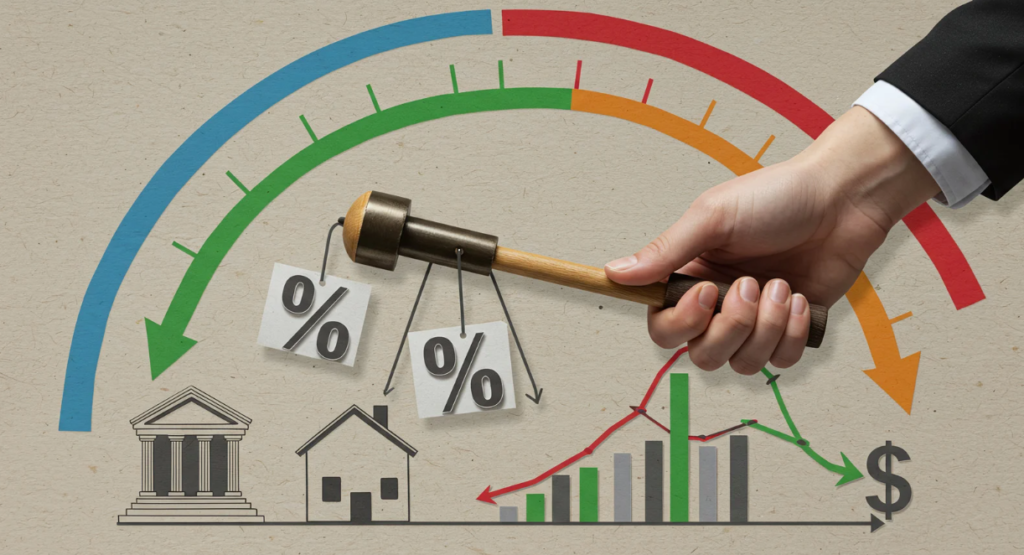
The global economy rarely moves in a straight line. Instead, it advances, pauses, and sometimes retreats. While technology, demographics, and resources play a role, one powerful force often sits behind sudden shifts. That force is policy uncertainty. When rules feel unstable, confidence weakens. When confidence weakens, decisions slow.
Understanding the policy uncertainty economy relationship helps explain why markets react sharply to political headlines. It also clarifies why businesses delay expansion and why households hesitate to spend. In short, uncertainty changes behavior long before laws actually change.
This article explores how policy uncertainty impacts the global economy. More importantly, it explains why uncertainty itself can become an economic shock.
Understanding policy uncertainty in the global economy
Policy uncertainty refers to unpredictability surrounding government actions. These actions may involve taxes, trade rules, regulations, or monetary policy. When outcomes feel unclear, economic actors struggle to plan.
In a stable environment, businesses forecast costs and returns. Consumers feel secure about income and prices. Investors allocate capital confidently. However, uncertainty disrupts those assumptions.
Within the policy uncertainty economy, expectations matter as much as outcomes. Even rumors or delayed decisions can shift behavior. As a result, uncertainty often produces real economic effects without any formal policy change.
Why policy uncertainty economy effects ripple globally
Modern economies are deeply interconnected. Supply chains cross borders. Capital flows instantly. Decisions in one country affect many others.
When a major economy faces policy uncertainty, global markets respond. Trade partners adjust forecasts. Currency values shift. Investment flows pause or reverse.
Therefore, policy uncertainty rarely remains local. Instead, it travels through financial markets, trade networks, and investor sentiment. This ripple effect explains why global growth often slows during uncertain political periods.
Investment decisions under policy uncertainty
Investment thrives on clarity. When future rules seem predictable, firms commit capital. When rules appear unstable, caution dominates.
Under policy uncertainty economy conditions, businesses delay projects. Expansion plans get postponed. Hiring slows. Cash reserves grow.
This hesitation reduces aggregate demand. Over time, lower investment weakens productivity growth. Consequently, uncertainty today can limit growth tomorrow.
Importantly, the impact does not require extreme policy shifts. Even prolonged debate can suppress investment momentum.
Corporate behavior and strategic hesitation
Firms respond to uncertainty strategically. Instead of long-term investments, they favor flexible options. Short-term contracts replace permanent commitments.
Additionally, companies may diversify operations geographically. While diversification reduces risk, it also increases costs.
Within the policy uncertainty economy, efficiency often gives way to caution. This shift may protect firms individually, yet it reduces overall economic efficiency.
Policy uncertainty and global trade flows
Trade depends on predictable rules. Tariffs, quotas, and trade agreements shape supply chains.
When trade policy becomes uncertain, firms rethink sourcing decisions. Contracts may be renegotiated. Inventory levels rise as buffers.
These adjustments increase costs. They also slow trade volumes. As a result, policy uncertainty economy pressures often show up in declining global trade growth.
Furthermore, uncertainty encourages protectionist behavior. Countries hedge against future restrictions, amplifying global fragmentation.
Financial markets and uncertainty-driven volatility
Financial markets react quickly to uncertainty. Prices adjust to expectations, not just facts.
During periods of policy uncertainty, volatility rises. Equity markets fluctuate. Bond yields shift. Currency markets react sharply.
Investors demand higher risk premiums. Consequently, borrowing costs increase. That increase affects governments, firms, and households alike.
Within the policy uncertainty economy, financial volatility becomes a transmission channel. Market stress spreads uncertainty into the real economy.
Monetary policy and uncertainty feedback loops
Central banks aim to stabilize economies. However, policy uncertainty complicates that mission.
When fiscal or regulatory paths remain unclear, monetary tools lose effectiveness. Rate cuts may not stimulate borrowing if confidence is low.
Moreover, central banks themselves may hesitate. Unclear political environments reduce policy coordination.
As a result, the policy uncertainty economy creates feedback loops. Uncertainty weakens policy impact, which prolongs uncertainty.
Consumer confidence and spending behavior
Households respond to uncertainty intuitively. When the future feels unstable, saving rises. Spending falls.
Big-ticket purchases get delayed. Housing decisions pause. Discretionary spending shrinks.
This behavioral shift affects aggregate demand. In economies driven by consumption, the impact becomes significant.
Policy uncertainty economy dynamics show that confidence, not just income, drives spending. Expectations shape everyday choices.
Labor markets under policy uncertainty
Employment decisions involve long-term commitments. Hiring becomes risky when future costs seem unclear.
During uncertain periods, firms slow hiring. Temporary contracts increase. Wage growth moderates.
Workers respond by reducing mobility. Job switching declines. Skill investment slows.
Over time, these patterns reduce labor market dynamism. The policy uncertainty economy thus affects employment quality, not just quantity.
Emerging markets and heightened sensitivity
Emerging economies often feel policy uncertainty more intensely. Capital flows respond quickly to global sentiment.
When uncertainty rises in major economies, investors retreat to perceived safety. Emerging markets face capital outflows.
Currency depreciation follows. Inflation pressures rise. Growth slows.
Therefore, the policy uncertainty economy impacts emerging markets disproportionately. External uncertainty becomes a domestic challenge.
Fiscal policy debates and economic drag
Fiscal policy uncertainty often centers on budgets, taxes, and public spending.
Prolonged budget negotiations create uncertainty. Businesses wait for clarity on tax rates. Households delay decisions.
Meanwhile, government spending stalls. Public investment projects pause.
This fiscal drag reduces growth momentum. Within the policy uncertainty economy, indecision itself becomes costly.
Regulatory uncertainty and innovation
Innovation thrives on clear frameworks. Entrepreneurs invest when rules feel stable.
Regulatory uncertainty discourages experimentation. Startups hesitate. Research slows.
In highly regulated sectors, uncertainty can freeze progress. Firms focus on compliance rather than innovation.
Thus, the policy uncertainty economy affects long-term competitiveness. Innovation pipelines weaken under unstable rules.
Geopolitical tensions and uncertainty escalation
Geopolitical events amplify policy uncertainty. Conflicts, sanctions, and alliances reshape expectations rapidly.
Markets struggle to price geopolitical risk. Supply chains face disruption. Energy and commodity prices fluctuate.
These shocks reinforce uncertainty cycles. Businesses retreat further into caution.
In the policy uncertainty economy, geopolitics acts as a multiplier. Local tensions create global economic consequences.
Measuring policy uncertainty
Economists track policy uncertainty using indices. These indices analyze news coverage, forecasts, and legislative activity.
Rising index values often correlate with lower investment and growth.
Although imperfect, these measures highlight patterns. They show how uncertainty precedes economic slowdowns.
Understanding measurement helps policymakers assess impact. Awareness supports better decision-making.
Short-term shocks versus long-term uncertainty
Not all uncertainty is equal. Short-lived shocks may fade quickly. Long-term uncertainty causes deeper damage.
Temporary uncertainty allows adaptation. Prolonged ambiguity erodes confidence steadily.
The policy uncertainty economy becomes most harmful when uncertainty persists. Length, not intensity, drives lasting impact.
Therefore, timely resolution matters as much as policy content.
Global coordination challenges
Global economic stability benefits from coordination. However, uncertainty complicates cooperation.
Diverging policy paths create friction. Trust weakens. Multilateral agreements stall.
As coordination declines, uncertainty rises further. This cycle fragments the global system.
Within the policy uncertainty economy, fragmentation reduces efficiency and growth potential.
Why certainty does not mean rigidity
Policy certainty does not require fixed rules forever. Instead, it requires transparent processes.
Clear timelines, communication, and gradual change reduce uncertainty.
Markets tolerate change when it feels predictable. Surprise creates disruption.
Thus, managing the policy uncertainty economy involves clarity, not stagnation.
Lessons from past periods of uncertainty
History offers insight. Periods of high uncertainty often align with slower growth.
Examples include trade disputes, fiscal standoffs, and regulatory overhauls.
In each case, confidence fell before data deteriorated.
These lessons highlight a key point. Expectations drive outcomes.
Policy communication as an economic tool
Communication shapes expectations. Clear messaging reduces speculation.
When policymakers explain intentions, markets adjust smoothly.
Poor communication increases volatility. Mixed signals confuse actors.
In the policy uncertainty economy, words matter as much as actions.
Adapting strategies in uncertain environments
Businesses adapt by increasing flexibility. Diversification rises. Risk management strengthens.
Investors adjust portfolios. Households increase savings.
While adaptive behavior protects individuals, it slows collective momentum.
Understanding these adaptations helps explain macroeconomic trends during uncertain periods.
Conclusion
Policy uncertainty impacts the global economy through behavior, not just rules. When expectations weaken, decisions slow. When decisions slow, growth suffers.
The policy uncertainty economy reveals how confidence, clarity, and communication shape outcomes. Uncertainty acts like friction, reducing efficiency across markets.
By recognizing these dynamics, policymakers can reduce unintended harm. Clear processes, transparent communication, and timely decisions matter.
In a connected world, managing uncertainty becomes a form of economic leadership. Stability begins with clarity.
FAQ
1. What is policy uncertainty economy?
It describes how unclear or unpredictable government actions affect economic behavior and outcomes.
2. How does policy uncertainty affect investment?
Uncertainty delays investment decisions, reduces capital spending, and weakens long-term growth.
3. Why does policy uncertainty impact global markets?
Because economies are interconnected, uncertainty in one country spreads through trade, finance, and confidence.
4. Can policy uncertainty cause recessions?
Prolonged uncertainty can contribute to recessions by suppressing investment, spending, and hiring.
5. How can policymakers reduce economic uncertainty?
Clear communication, predictable processes, and timely decisions help stabilize expectations and support growth.